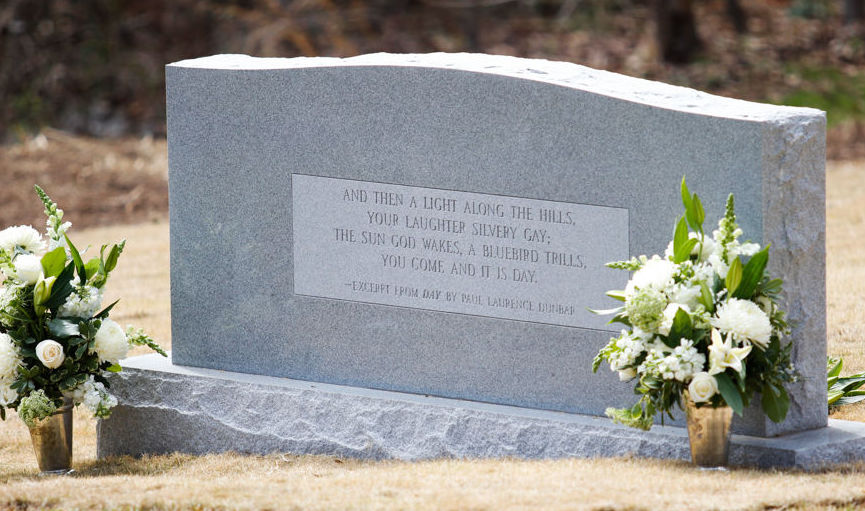
The gravemarker used during the reinternment ceremony in March 2017. The quote is an excerpt from Paul Laurence Dunbar, which reads:
"And then a light along the hills, your laughter silver gay; the sun God wakes up, a bluebird trills, you come and it is day."
Lefevre, Kaley. "UGA continues ressearch on Baldwin Hall" in The Red & Black. June 9, 2017. (see source here).
After the discovery of enslaved remains under a UGA academic building in 2015, historians from UGA compiled digital archives to demonstrate UGA's participation in slavery. UGA engaged in the “hiring out system, in which one party hires enslaved people from an enslaver for their use” (Benjamin Pope Accounts, can be found here). The archive introduction, probably from administrative pressure, underscores that as an institution, UGA did not officially “own” enslaved people; nevertheless, enslaved people were still “integral to the functionality of the early university” through cleaning students’ rooms, maintaining buildings through needed repairs, and supplying water for campus and working in the Botanical Gardens (see source here). Enslaved labor was so integral to maintaining UGA’s functionality that part of students’ tuition and fees include a line for “servant’s hire” (see source here).
Thus, slavery was very much a part of the University of Georgia and more importantly ensured the university’s economic profit and success.
Using Elon Dancy II, Kirsten T. Edwards, and James Earl Davis’s theory that the current university system remains a plantation economy through endured Black labor for the university (2018), how is the fact that enslaved people labored for the University of Georgia in the 1800s any different than the fact that today 44% of UGA’s Service and Maintenance staff is African American? (Lavine, 2019). Although the non-white laborers for UGA are not solely African American, the fact that African Americans make up almost half of the Service and Maintenance staff yet only 5% of faculty and 7% of the administration staff demonstrates how key these underpaid laborers are to the “functionality” of the university (Lavine). Custodians, adjunct professors, athletes, even overworked tenure-seeking professors, are all essential to the successful functioning of any university system, and African Americans are the predominant people in these occupations, particularly completing the majority of custodial duties at UGA. “Black people are [still] cleaning up for white people at poverty wages and we can't pretend that it’s an accident" (Irami Osei-Frimpong qtd. in. Lavine).
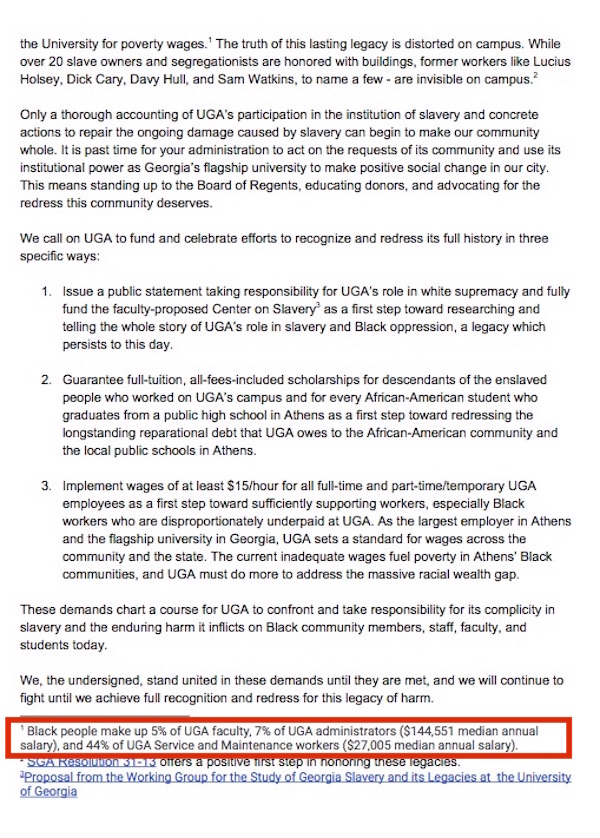
The second page of a letter for Racial Justice Demands given to UGA President Moorehead from student activists. The text boxed in red is the footnote citing the small percentage of Black faculty and students at UGA compared to the large percentage of Black Maintenance and Staff workers at UGA.
Webb, Ashlyn. “Activists Deliver Letter to Moorehead Demanding UGA Reparations for
Slavery.” Flagpole. Athens, GA. 10 April 2019. (see source here).
Enslaved African people labored at the university, but their descendants were not allowed to attend as students until 1961, and just barely. Hamilton Holmes and Charlayne Hunter-Gault were the first Black students to attend UGA after successfully suing the university, where a federal judge ordered UGA to admit them (Chiles, 2016). Holmes et al. v Danner coupled with the Sibley Commission of 1960 propped UGA up as the reason to de-segregate all public schools in Georgia, but ironically, UGA only integrated because the school was threatened to be shut down if they refused to. Even though integration was technically reached at UGA, once Holmes and Hunter-Gault were on campus, they were met with harsh racist realities, including white riots outside of their dorms (Stirgus).
Lack of Black student representation and hardship has continued today, as UGA’s Black students represent 7% of the student population while white students comprise 69% of the undergraduate student population (UGA Office of Institutional Research). The small number of Black students who do attend the University of Georgia undoubtedly face hardships in navigating a majority-white institution; some Black students reported in 2016 that they experienced moments of social discomfort and unease on campus due to their race (Chiles). Also, out of the 15% of students of color in the Athens-Clarke County school system, only 1% of them go on to attend UGA (Lavine). And as stated, 44% of UGA’s Service and Maintenance staff are African Americans who make a median annual salary of $27,000, thus African Americans continue to overwork and sustain the university, with the slimmer chance that their children will attend UGA (Lavine).